
Powering Railway Sensors with Isolated DC/DC Converters
2022. 11. 25

Many people think of a train as simply a bus on rails. After all, passenger trains have been around since 1825, and the basic concept of a locomotive pulling carriages has not changed significantly since then.
However, anyone attending the recent Innotrans 2024 exhibition in Berlin, the leading international trade fair for transport technology, would have noticed that trains are becoming increasingly high-tech. One exhibitor even claimed that their high-speed train contained over 7000 sensors, far exceeding what would normally be needed in any bus.
One reason for this massive increase in sensors is the ongoing demand for improvements in safety, reliability, comfort, and performance in modern railway infrastructure. But how can passenger safety be enhanced in existing rolling stock that has a working life of decades and is already several years old? The solution is to retrofit advanced sensors and monitoring systems, adding a layer of control and communication on top of the existing mechanical systems.
A modern train already shares more in common with an IT server installation than it might appear. An on-board ethernet backbone supports CCTV and PA systems running over an IP network, transmits real-time information for passenger information systems, provides Wi-Fi access points and seat reservation displays, and interfaces with distributed processor and gateway units for control, while monitoring and diagnosing with the central train control and management system (TCMS).

Fig. 1: Train Ethernet Network
So, what types of sensors are required, and why are so many needed? On a typical high-speed train, there may be up to 16 different subsystems for control, monitoring, and diagnostics—all requiring sensors to measure real-time parameters. The main systems include:
One reason for this massive increase in sensors is the ongoing demand for improvements in safety, reliability, comfort, and performance in modern railway infrastructure. But how can passenger safety be enhanced in existing rolling stock that has a working life of decades and is already several years old? The solution is to retrofit advanced sensors and monitoring systems, adding a layer of control and communication on top of the existing mechanical systems.
A modern train already shares more in common with an IT server installation than it might appear. An on-board ethernet backbone supports CCTV and PA systems running over an IP network, transmits real-time information for passenger information systems, provides Wi-Fi access points and seat reservation displays, and interfaces with distributed processor and gateway units for control, while monitoring and diagnosing with the central train control and management system (TCMS).

Fig. 1: Train Ethernet Network
So, what types of sensors are required, and why are so many needed? On a typical high-speed train, there may be up to 16 different subsystems for control, monitoring, and diagnostics—all requiring sensors to measure real-time parameters. The main systems include:
HVAC Systems in Railway Cars
The Heating, Ventilation, and Air-Conditioning (HVAC) units are roof-mounted and maintain the passenger environment, keeping it warm in winter and cool in summer. They also circulate and filter the air inside the carriages, which was particularly important during the Covid pandemic. Approximately 10–30% of the air is refreshed each minute, making it crucial to keep fan noise low and ensure the circulation system flushes out all aerosols without leaving dead spaces in footwells, corners, or ceiling areas.
Sensors commonly required in railway HVAC systems include temperature (internal, external, coolant, and evaporator core), relative humidity, pressure (differential, absolute, and vacuum), mass-flow, sunlight (to adjust heating/cooling rate), filter air restriction, and air quality (CO2, VOCs, and particulates).
Sensors commonly required in railway HVAC systems include temperature (internal, external, coolant, and evaporator core), relative humidity, pressure (differential, absolute, and vacuum), mass-flow, sunlight (to adjust heating/cooling rate), filter air restriction, and air quality (CO2, VOCs, and particulates).
Bogie Assembly Monitoring and Sensors
The bogie assembly consists of wheels and axles, bearings, primary suspension, and brakes. In electric trains, it also includes the traction motor, coupling, and gearbox mechanisms. This is the harshest rolling stock environment, requiring highly robust and reliable sensors.
Sensors in a motor bogie include motor, bearing, brake, and gearbox temperature; shock and vibration; air or hydraulic pressure in brake cylinders; traction control; non-contact magnetic wheel slide, gear, and speed sensors; and neutral track detectors (to indicate overhead power line sections).
Sensors in a motor bogie include motor, bearing, brake, and gearbox temperature; shock and vibration; air or hydraulic pressure in brake cylinders; traction control; non-contact magnetic wheel slide, gear, and speed sensors; and neutral track detectors (to indicate overhead power line sections).
Train Door Control and Safety Sensors
To prevent carriage doors from opening during travel—due to faults or pressure waves from passing trains—railway door safety requirements are strict, making door sensing and control complex. Automatic entry or exit doors are typically electrically operated, while inter-carriage or toilet doors are mechanically operated or pneumatic, as vacuum flush toilets already provide a pneumatic connection. Toilets also require multiple sensors, including water and waste tank levels, air and vacuum pressure, occupancy, and passenger alarm detectors.
Door mechanism sensors include door opening/closing speed and position, force sensors (to detect obstructions), actuator and linkage angle sensors, capacitive or vandal-proof push-buttons, and monitoring to detect wear. Each door controller reports to the TCMS to ensure all doors are properly closed before the train departs.
Door mechanism sensors include door opening/closing speed and position, force sensors (to detect obstructions), actuator and linkage angle sensors, capacitive or vandal-proof push-buttons, and monitoring to detect wear. Each door controller reports to the TCMS to ensure all doors are properly closed before the train departs.
Passenger Information Systems (PIS) and Interfaces
Passenger information systems (PIS) assist passengers in preparing to leave the train at the next station and inform them of the train’s progress or any delays. Some systems provide local weather updates and incorporate news, entertainment, or advertisements. On older trains, announcements might be made via PA systems, but modern intercity and regional trains use bulkhead or ceiling-mounted TFT or LED dot-matrix displays. Data is transmitted and updated via 100Mbps ethernet or RS485 serial buses linked to seat reservation displays.
Sensors for PIS include ambient light to adjust display brightness, ambient noise to adjust speaker volume, GPS for position tracking, and touchscreen sensors for human-machine interface (HMI) displays. CCTV or thermal cameras can integrate with PIS audio/visual systems to determine seat occupancy or detect fires.
Sensors for PIS include ambient light to adjust display brightness, ambient noise to adjust speaker volume, GPS for position tracking, and touchscreen sensors for human-machine interface (HMI) displays. CCTV or thermal cameras can integrate with PIS audio/visual systems to determine seat occupancy or detect fires.

Fig. 2: Train subsystems
Scaling Sensor Networks in Modern High-Speed Trains
Although only four of the 16 subsystems have been examined, it is clear why the high-speed train mentioned earlier needed over 7000 sensors.Most sensors are powered from 24VDC, the industry standard, but some may draw from the primary train power supply, usually 110VDC. While multiple sensors connected to a local controller can share a single supply, it is often better to separate and isolate supply rails for system fault tolerance. If one sensor is damaged or the cabling shorts, it should not compromise the entire system.

In a poor power and daisy-chained data connection scheme, a single sensor failure could pull down the 24VDC supply, disabling the controller and other sensors. Even an open-circuit failure could break the data daisy chain, disrupting communication for sensors downstream.

In an improved sensor and data communication scheme, each component is powered by a separate isolated DC/DC converter, providing continuous short-circuit protection. A single sensor failure does not affect other components or overload the 110VDC supply. Data communication via a multi-drop bus network continues even if a defective sensor does not pull down the bus. The controller can detect faults and alert the TCMS if the data bus is compromised.
For full single fault tolerance on all power and data lines, the following topology is used (Figure 5).
For full single fault tolerance on all power and data lines, the following topology is used (Figure 5).

The controller’s power supply is redundant, so if one DC/DC converter fails, the other maintains the required current. Standard DC/DC converters lack this ‘OR’ function, requiring special versions. RECOM Plug & Play power solutions provide true current sharing, allowing supplies to be paralleled for N+1 redundancy or increased current arrangements. N+1 redundant supply or as an increased current power supply arrangement.
On the low-voltage side, each sensor has an isolated DC/DC power supply and data interface. This ensures that if a sensor fails, it does not pull down the power or data bus. Even a short circuit to a higher voltage (e.g., 110VDC) cannot feed back and damage the controller’s internal power supply or data bus.
RECOM also offers board-level DC/DC converters for isolated sensor interfaces, including an 8W EN 50155-certified DIP24 unit (32 x 20.3 x 11.2mm) and 20W or 30W EN 50155-certified units in a 1” x 1” case.

Fig. 7: RECOM’s RP08, RP12, RPA20 and RPA30 PCB-mount railway-grade DC/DC converters
For more demanding railway applications, including sensor/actuator combinations, RECOM offers higher-power board-level isolated DC/DC converters up to 200W with 4:1 or ultra-wide 10:1 input ranges, continuous output short-circuit protection, and EN 50155 certification.

Fig. 8: RECOM Front-end to Back-end Railway Power Supply Solutions
Currently, only RECOM offers such a comprehensive range of railway-grade DC/DC converters to enable rapid sensor implementation or retrofitting to existing rolling stock. Pre-certified to EN50155, they also comply with major technical railway standards, including EN50121-3-2 for EMC, EN50124-1 for safety insulation, EN50125-1 for environmental conditions, and EN45545-2 for fire safety.
On the low-voltage side, each sensor has an isolated DC/DC power supply and data interface. This ensures that if a sensor fails, it does not pull down the power or data bus. Even a short circuit to a higher voltage (e.g., 110VDC) cannot feed back and damage the controller’s internal power supply or data bus.
RECOM DC/DC Converters for Railway Sensor Integration
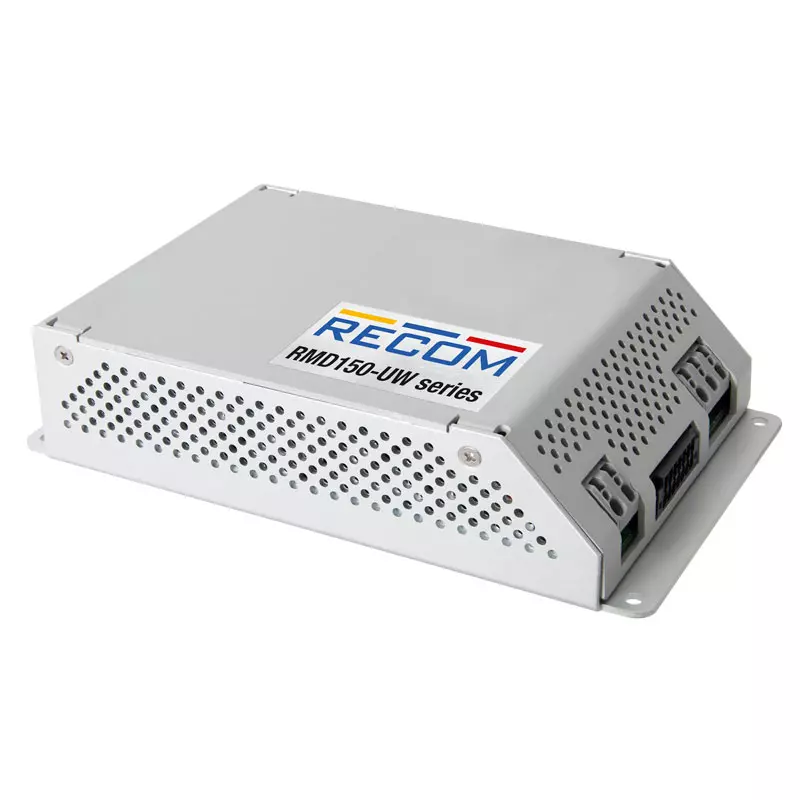
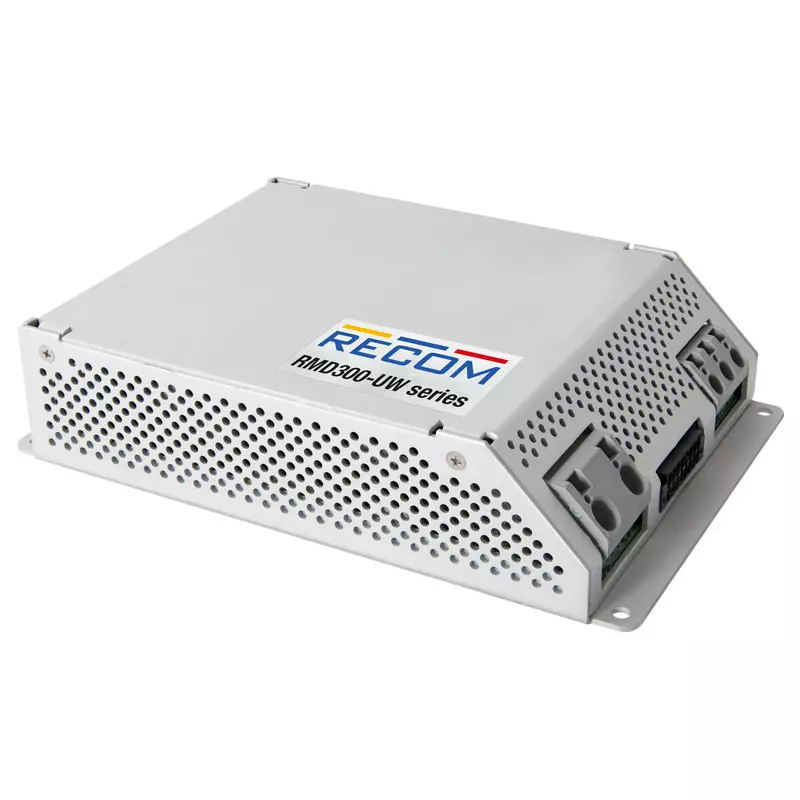
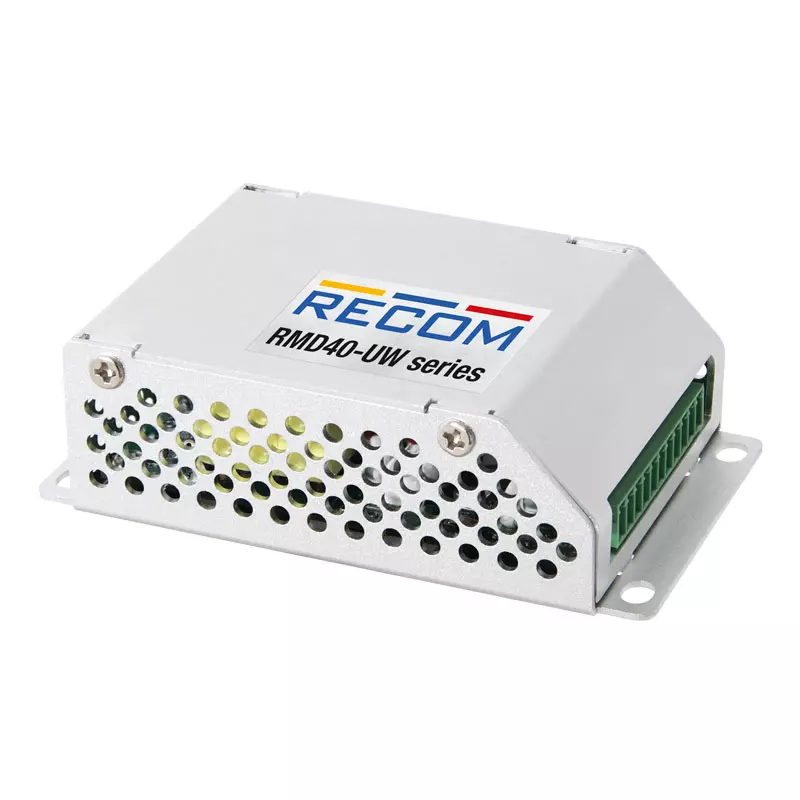
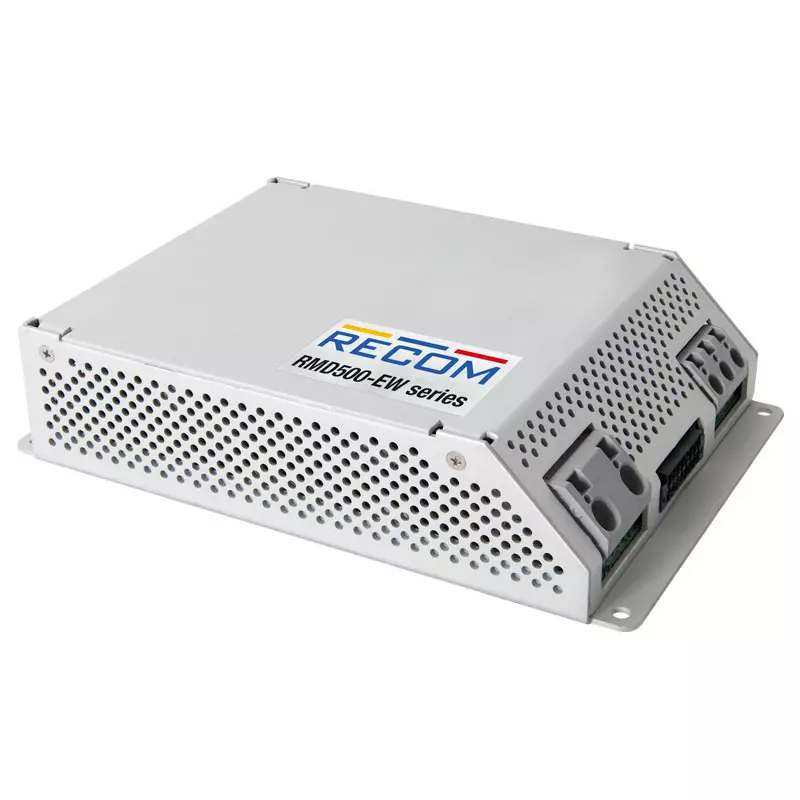
RECOM manufactures all-in-one DC/DC power supplies with railway-grade EMC filters, reverse polarity protection, and output paralleling from 40W to 1000W, maintaining equal current sharing and stable V/I characteristics. Input voltage ranges include 4:1 24V, 36V, 110V, or ultra-wide 14.4–170VDC, covering standard requirements. They meet temperature class OT4 + ST1 & ST2, provide full output power, and allow natural convection cooling.
RECOM also offers board-level DC/DC converters for isolated sensor interfaces, including an 8W EN 50155-certified DIP24 unit (32 x 20.3 x 11.2mm) and 20W or 30W EN 50155-certified units in a 1” x 1” case.

Fig. 7: RECOM’s RP08, RP12, RPA20 and RPA30 PCB-mount railway-grade DC/DC converters
For more demanding railway applications, including sensor/actuator combinations, RECOM offers higher-power board-level isolated DC/DC converters up to 200W with 4:1 or ultra-wide 10:1 input ranges, continuous output short-circuit protection, and EN 50155 certification.

Fig. 8: RECOM Front-end to Back-end Railway Power Supply Solutions
Currently, only RECOM offers such a comprehensive range of railway-grade DC/DC converters to enable rapid sensor implementation or retrofitting to existing rolling stock. Pre-certified to EN50155, they also comply with major technical railway standards, including EN50121-3-2 for EMC, EN50124-1 for safety insulation, EN50125-1 for environmental conditions, and EN45545-2 for fire safety.
용도


| Series | |||||||
|---|---|---|---|---|---|---|---|
| 1 |
|
RMD150-UW
Focus
|
|
| |||
| 2 |
|
RMD300-UW
Focus
|
|
| |||
| 3 |
|
RMD40-UW
Focus
신규
|
|
| |||
| 4 |
|
RMD500-EW
Focus
|
|
| |||
| 5 |

|
RMD75-UW
Focus
신규
|
|
| |||
| 6 |

|
RP08-AW
Focus
|
|
| |||
| 7 |

|
RPA20-FR
Focus
|
|
| |||
| 8 |

|
RP08-A
|
|
| |||
| 9 |

|
RP12-A
|
|
| |||
| 10 |

|
RP12-AR
|
|
| |||
| 11 |

|
RP12-AW
|
|
| |||
| 12 |
|
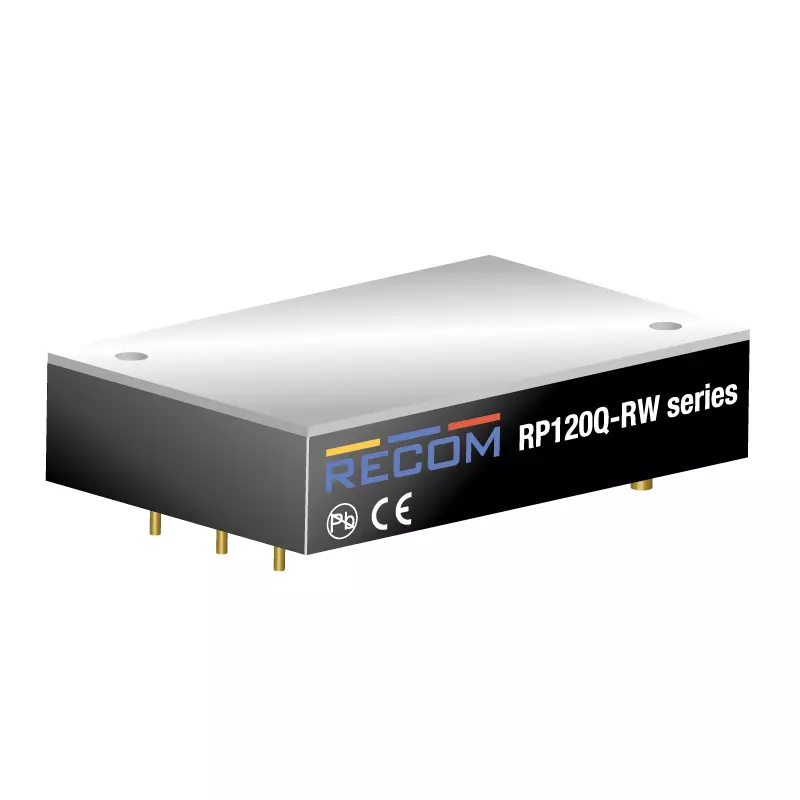
RP120Q-RW
|
|
| |||
| 13 |

|
RPA20-AW
NRND
|
|
| |||
| 14 |

|
RPA30-AW
NRND
|
|
|