To protect electrical equipment connected to power distribution systems from the hazardous effects of transient voltages, the International Electrotechnical Commission (IEC) introduced the IEC 60204-1 standard. This standard categorizes devices based on their transient tolerance and sets conditional category requirements. Titled "Safety of Machinery - Electrical Equipment of Machines - Part 1: General Requirements," it defines four categories of transient voltage tolerance at different operating voltages.
Transient Voltage Tolerance by Operating Voltage Levels |
| Working Voltage |
Category I |
Category II |
Category III |
Category IV |
| 150 |
800 |
1500 |
2500 |
4000 |
| 300 |
1500 |
2500 |
4000 |
6000 |
| 600 |
2500 |
4000 |
6000 |
8000 |
| 1000 |
4000 |
6000 |
8000 |
1200 |
| Source Impedance |
30Ω |
12Ω |
2Ω |
2Ω |
Table 1: Transient Voltage tolerance at different operating voltages
In dieser Tabelle sind verschiedene Betriebsspannungen den jeweils tolerierten Schwellenwerten für transiente Spannungen zugeordnet. Ein Gerät, das beispielsweise mit 300V arbeitet und transienten Spannungen von 4000V standhält, wird der Kategorie III zugewiesen.
Overvoltage Category (OVC) Requirements for Electrical Safety
The primary purpose of IEC 60204-1 is to define condition-based requirements for devices to achieve a specific
overvoltage category (OVC) rating, ensuring safe use. As shown in the table above, all power devices and wiring must be classified by an OVC ranking. Depending on the connection conditions, a device may be required to meet a specified OVC rating. For example, if robotic machinery is directly connected to a distribution panel, IEC 60204 mandates that the wiring between the panel and devices be rated OVC III, and the power supply within the machinery must also meet OVC III.
If the robotic machinery power supply cannot meet OVC III ratings, an OVC III isolation transformer must be installed between the distribution panel and the machinery. The isolation transformer reduces the voltage from the distribution panel, lowering the OVC requirement for the machinery power supply and wiring to OVC II. In many cases, power supply selection can impact cost and space considerations, as additional isolation equipment may be required to meet end-user specifications.
The installation categories defined by IEC 60204-1:2016, ranked from least to most exposed to high-voltage transients, are:
OVC III Power Supplies for Reliable Power Electronics
From a financial perspective, systems that do not require supplemental equipment have a competitive advantage. Reducing part count in critical applications also lowers potential failure points. Using OVC-qualified power supplies under appropriate conditions provides distinct benefits. For example, RECOM’s
RAC05-K/480 and
RAC03E-K/277 AC/DC power supplies are certified for OVC III use with an ultrawide input range. The RAC05-K/480 offers 100-480VAC nominal input, 5W output, 4kV isolation, and selectable output voltages of 5V, 12V, or 15V.
The cost-efficient RAC03E-K/277 supports 100-277VAC input, making it suitable for global applications in automation control, Industry 4.0, IoT, and home automation. The RAC05-K/480 can be directly connected to a distribution panel for 5V applications such as smart grids, renewable energy, smart metering, and
IoT systems applications.
For higher power needs, the
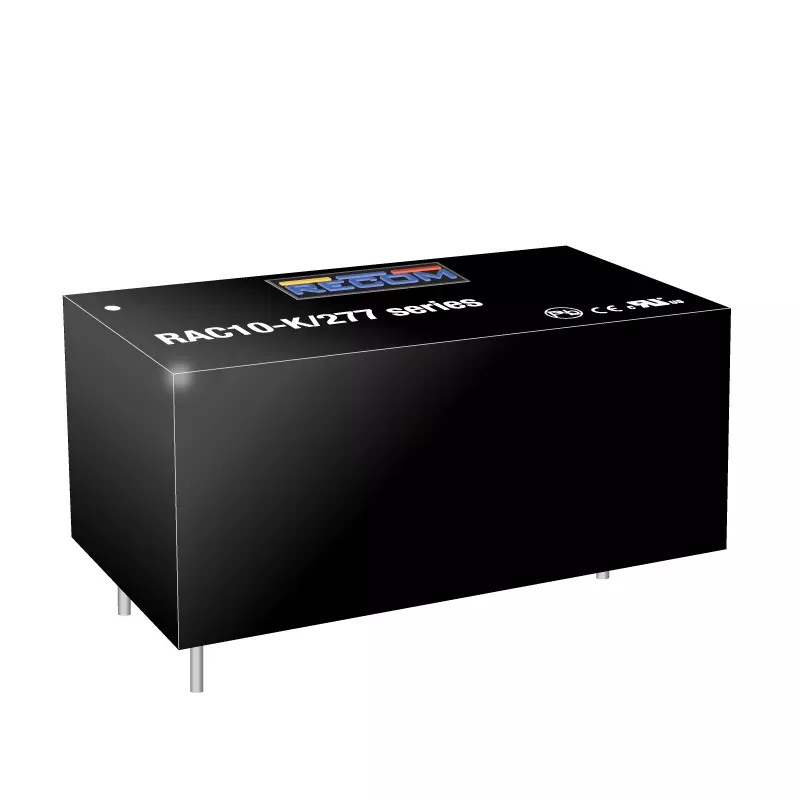
RAC10-K/277 series outputs 10W with an input range of 85-277V and output voltages from 3.3V to 24V. Both RAC05-K and RAC10-K power supplies are ideal for always-on and standby operations in process automation, IoT, and
smart building systems. The
RAC20-K/277 and
RACM40-K series can be customized to meet OVC III requirements. Using OVC III-qualified power supplies in always-on IoT applications reduces total cost of ownership, BOM complexity, product intricacy, and installation requirements, giving products a competitive distinction.