How to Hack your DC/DC Converter - Part 1

Hacker with laptop that says Part 1
A ‘hack’ is a clever or elegant solution that uses something for a purpose for which it was not originally intended, usually for fun, but also more seriously to provide a solution that would otherwise not be possible. But how can you ‘hack’ something as basic as a DC/DC converter module? This article uses the example of an isolated gate driver power supply to show four possible DC/DC converter ‘hacks’ that can be applied to many other applications.

It is based on the RxxPxx series of power converters from RECOM, which have 6.4kVDC basic isolation (250VAC working voltage), an industrial operating temperature range, and low isolation capacitance; therefore, they are particularly suitable for powering high-voltage isolated gate driver circuits.

Important note: Using any electronic component outside of its intended operational range will invalidate its warranty. If you decide to apply any of the following solutions, please contact the manufacturer and obtain approval in advance.

Suppose you have a SiC transistor application that requires a positive gate drive voltage of around +15V and a negative gate drive voltage of around -4V for optimum performance with the lowest switching losses (Figure 1).

Isolated DC/DC converter and gate driver.

Fig 1: Simplified schematic of an isolated SiC transistor gate driver circuit

You check the manufacturer’s datasheets and find that an isolated DC/DC converter with this particular asymmetric output voltage combination does not exist as a standard product. What can you do?

Hack #1: Use an Out-of-Spec Input Voltage

Low-power unregulated DC/DC converters typically have an output/input voltage variation ratio of 1.2%/1% of Vin at full load. In other words, if the input voltage is 10% above or below nominal, the output voltage will be around 12% too high or too low, so any variations in input voltage are amplified. The voltage ratio improves linearly with reducing load; at 50% load, it is around 1.1%/1% of Vin, and at minimum load it is roughly parity (1%/1%). To allow comparison between different manufacturers’ datasheets, the electronics industry has standardized line regulation specifications for unregulated converters over a ±10% variation in supply voltage. But what happens if the input voltage is set outside this range?

The converter will still function, but performance parameters are no longer guaranteed by the datasheet specifications. If the input voltage is too low or too high, the output voltage will also be too low or too high and therefore out-of-specification, which can be useful in certain circumstances. The following images (Figure 2) and test results (Table 1) show measured circuit voltages using the RECOM R-REF01-HB evaluation board driving a SiC MOSFET with a 1MHz PWM switching signal:
Three multimeters displaying different readings on a desk
Fig. 2: Test results with an R12P22005D DC/DC converter with isolated +20/-5V outputs with a nominal 12V input (left) and 10.8V supply (right), both measured under a realistic 60% load, powering an active SiC transistor gate driver.


DC Input Voltage Output voltage (+ve) Output Voltage (-ve)
12.0V (nominal) +20.1V (nominal) -5.1V (nominal)
10.8V (-10%) +18.0V -4.6V
9.6V (-20%) +16.0V -4.0V
Table 1: 2W isolated asymmetric output voltage DC/DC converter (R12P22005D) with nominal 12V, nom-10% and out-of-spec nom-20% supply voltages, measured with a 60% load.

As can be seen from this hack, setting the input voltage to -20% below nominal (9.6V) results in the desired non-standard output voltages, even though the input voltage is outside of the datasheet specifications.

How far can we go with this hack? Well, let’s see:

Input Voltage Output voltage (+ve) Output Voltage (-ve)
12.0V (nominal) +20.1V (nominal) -5.1V (nominal)
10.8V (-10%) +18.0V -4.6V
10.2V (-15%) +17.5V -4.5V
9.6V (-20%) +16.0V -4.0V
9.0V (-25%) +15.4V -3.9V
7.0V (-40%) +12V -3V
6.0V (-50%) +10V -2.5V
Table 2: 2W isolated asymmetric output voltage DC/DC converter (R12P22005D) with nominal and out-of-spec under-voltage supply voltages, operating with 60% load (line reg. ≈ 1.1%/1% of Vin).

In the other direction:

Input Voltage Output voltage (+ve) Output Voltage (-ve)
12.0V (nominal) +20.1V (nominal) -5.1V (nominal)
13.2V (+10%) +22.6V -5.8V
13.8V (+15%) +23.5V -6.0V
14.4V (+20%) +24.7V -6.3V
Table 3: 2W isolated asymmetric output voltage DC/DC converter (R12P22005D) with out-of-spec over-voltage supply voltages, operating at 60% load (line reg. ≈ 1.1%/1% of Vin).

The converter does not suddenly stop functioning even when the input voltage is far outside the ±10% limits provided in the datasheet.

Caveat: Operating the converter outside its specified input voltage range increases internal stress, so other specifications such as efficiency, output ripple, and operating temperature range may not be met. If the input voltage is very low, the increased input current could cause the primary side components to overheat. If the input voltage is too high, the internal capacitor and transistor voltage ratings may be exceeded. Both out-of-spec conditions can allow the output voltage to drift significantly with ambient temperature or load changes; therefore, use this hack with caution.

For a more dependable solution to generate a non-standard +15V/-4V asymmetric output voltage, a semi-regulated circuit is needed:

Hack #2: Regulate a Single Output on an Isolated Converter

Using an asymmetric output DC/DC converter such as the RxxP21509D with +15/-9V nominal outputs, if one output voltage is correct, the other can be easily post-regulated down to the desired output voltage. For our isolated gate driver power supply example, the negative rail output current is lower than the positive rail current; thus, a Zener diode with a general-purpose NPN bipolar transistor regulator solution can be used (Figure 3).

Circuit diagram with 12V supply and isolated gate driver

Fig 3: Negative rail regulated solution

The advantage of this solution is that the DC/DC converter operates within its datasheet specification range, so both performance and warranty are unaffected, including operation over the full industrial ambient temperature range of -40°C to +85°C without derating. Additionally, the negative rail is now regulated, remaining fixed and independent of load or input voltage variations, and can be set to any desired voltage within range by selecting a different Zener diode voltage. The same technique can regulate the positive rail if it is more critical than the negative rail (see Hack #3).

The disadvantage of this hack is that the regulated rail current is limited by transistor power dissipation. In this example, the NPN transistor drops around 5V, limiting it to a maximum of -100mA average load current (note: the peak gate charge/discharge current is supplied from the output capacitors, so only average current drain is considered).

If more output current is needed without excessive heat, stacked converters are a better solution:

Hack #3: Stacked DC/DC Converters for Higher Gate Drive Power

The average power consumed by a gate driver depends on gate drive voltage swing, transistor gate charge, and switching frequency; it can be approximated by the following equation:
Gate driver power equation

More gate drive power is required when switching at higher frequencies or driving paralleled gates to increase output current. As the gate drive voltage in our example is asymmetric (+15V/-4V), more power is needed on the Vgate positive swing than the negative swing. If the power consumption exceeds a single isolated DC/DC converter’s capability, two stacked converters can be used (Figure 4). This hack delivers +16V @ 2W and -5V @ 0.7W:

Electronic circuit schematic

Fig 4: Stacked DC/DC converters

The R12P209D dual-output DC/DC converter is used with the common pin disconnected, creating an unregulated 18V/222mA supply. This is regulated down to the +16V VDD rail by the Zener and NPN transistor combination. The NPN has double the current but drops only half the voltage, keeping transistor power dissipation similar to Hack #2.

Additionally, the 5V linear regulator for the gate driver non-isolated primary side has been replaced with a cost-effective R-78E switching regulator module capable of delivering 5V at up to 500mA. This supplies both the gate driver primary side and the R05P05S DC/DC converter for the isolated -5V output rail, meaning variations in the 12V supply are now regulated out in the negative rail. Operating an unregulated DC/DC converter from a regulated supply improves overall system performance and forms the basis for the next hack: using cascaded converters.

Hack #4: Cascaded DC/DC Converters for Adjustable Asymmetric Output

As seen from Hack #1, the output voltage of an unregulated DC/DC converter can be adjusted by modifying the input voltage. If an adjustable output isolated asymmetrical gate driver voltage is needed, adding cost-effective, non-isolated pre-regulator DC/DC modules can create a gate driver circuit adjustable across a wide range of gate voltages. This hack is useful to test and determine which combination of positive and negative drive voltages offers the highest performance with the lowest losses. Fixed voltage trimming resistors can then set the optimal output voltage combination:

Voltage regulator circuit diagram

Fig 5: Adjustable asymmetric output isolated gate driver power supply

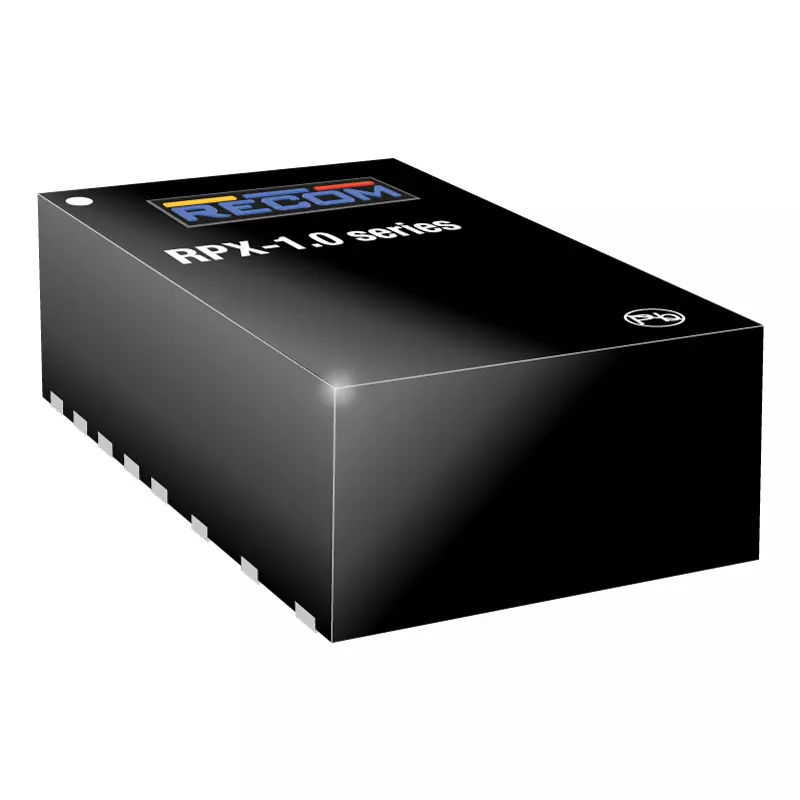
The RPX-1.0 is a cost-effective SMD DC/DC module offering a wide output voltage adjustment range (0.8–30V) and 1A continuous output current. The output voltage can be pre-set with two resistors or made variable using a trimmer resistor, as in this hack. As with all hacks, using any product outside its intended use requires caution, even if the motto “If it’s stupid and it works, then it’s not stupid” applies.

If in doubt, contact RECOM's technical support. They can test the solution and advise on suitability for your application. For volume production, modified standard converters with any desired input and output voltage combinations are available, providing a semi-custom solution with full manufacturer warranty.

This article is the first part of a two-part series, the second being “How to hack your AC/DC converter”.
Applications
  Series
1 RECOM | RPX-1.0 Series | DC/DC, SMD (pinless), 5W, Single Output
Focus
  • Buck regulator power module with integrated shielded inductor
  • 36VDC input voltage, 1A output current
  • SCP, OCP, OTP, and UVLO protection
  • 3.0 x 5.0mm low profile QFN package
2 RECOM | R-REF01-HB Series | DC/DC
  • Half-bridge voltage up to 1kV
  • TTL-compatible signal input
  • Single 15V to 42V supply
  • Shoot-through protection
3 RECOM | RxxP21509 Series | DC/DC, THT, 2W, Dual Output
  • +20/-5V & +15/-3V asymmetric outputs for SiC driver applications
  • Qualified with 65kV/µs @ Vcommon mode =1KV
  • +15/-9V asymmetric outputs for IGBT driver applications
  • Pot-core transformer with separated windings
4 RECOM | RxxP22005 Series | DC/DC, THT, 2W, Dual Output
  • +20/-5V & +15/-3V asymmetric outputs for SiC driver applications
  • Qualified with 65kV/µs @ Vcommon mode =1KV
  • +15/-9V asymmetric outputs for IGBT driver applications
  • Pot-core transformer with separated windings
5 RECOM | RxxPxx Series | DC/DC, THT, 1W
  • UL/CSA and IEC/EN safety certified
  • High isolation 6.4kVDC
  • Optional continuous short circuit protection
  • /X2 version with >9mm input/output clearance