A ‘hack’ is a clever or elegant solution that uses a device for a purpose it was not originally intended for. It is often for fun, but more importantly, it offers solutions that would otherwise be impossible. But how can you ‘hack’ something as fundamental as an AC/DC converter module? This article uses the example of a board-mounted AC/DC power supply to demonstrate five possible AC/DC converter hacks that can also be applied to other applications.
Let’s assume you have a power monitoring application in an electric vehicle (EV) charging system, where the auxiliary power supply needs multiple input options: three-phase or single-phase AC, or high-voltage DC or low-voltage DC. Additionally, the charging system must generate bipolar (±10V) output rails to power calibrated current and voltage sensors and amplifiers (Figure 1).
Fig. 1: EV charging system with universal AC or DC supply.
You check the manufacturer’s datasheets and find that a power supply covering all these input and output voltage combinations does not exist as a standard product. What can you do? You need to start hacking your AC/DC power supply.
Hack #1: Use Dropper Diodes in AC/DC Converters
Fig. 2: Diode dropper
Low-power AC/DC converters do not normally provide adjustable output voltages. The reason is simple: unlike a 24-5V isolated DC/DC converter, which might have a transformer with a 5:1 turns ratio, an equivalent AC/DC converter with 230VAC RMS input to 5V output requires a transformer with a 65:1 turns ratio. This is because the rectified AC voltage is significantly higher than the output voltage.
The control loop in an AC/DC converter is optimized to compensate for a wide range of input voltages (typically 85-264VAC) and a fixed output voltage. Making the output voltage adjustable could easily make the converter unstable due to the high turns ratio combined with worst-case input/output voltage combinations.
It is possible to place positive and negative voltage LDO linear regulators on an AC/DC with ±12V outputs to regulate down to ±10V, but is there a simpler, cheaper hack? Silicon diodes typically have a 0.6V-0.7V forward voltage drop. Hence, three in series will drop 2.1V (Figure 2). The heat dissipation in the diodes must be properly managed; for a 500mA output current, the power dissipation is 350mW, requiring suitably rated diodes.
Fig. 3: Diode dropper battery trickle charger.
A similar approach can be applied on a single-output AC/DC module to drop a 15V output down to approximately 13.6-13.8V to trickle charge a 12V battery by inserting two diodes in series with +Vout (Figure 3). Such trickle chargers are useful in applications such as emergency lighting or fire alarms, which are normally mains powered but must also operate independently without AC.
Using dropper diodes is a ‘quick and dirty’ hack; however, it is inefficient due to power dissipation. Adding output switching regulators is more efficient and allows adjustable output voltage, leading into the next hack:
Hack #2: Adjustable Bipolar Output Rails for AC/DC Modules
Fig. 4: Adjustable bipolar (±) output rails from a single-output AC/DC converter.
Negative voltage regulators are expensive and require a bipolar output power supply. Is it possible to create a dual-rail supply from a single-output AC/DC? This hack demonstrates how. Switching regulators function similarly to linear regulators and have several pin-compatible modules available (e.g., RECOM’s R-78 series). Internally, however, they differ significantly. If the output of a switching regulator is tied to ground, the GND pin goes negative, creating a positive-to-negative regulator (Figure 4).
Figure 4 shows a multiple-output power supply (+12V, adjustable +1 to +10V, and adjustable -1 to -10V) using only three cost-effective main components. The RAC05-12SK is a universal AC input (85VAC to 264VAC) 5W board-mount power supply that, despite its 1”x1” footprint, requires no external components. Fuse and Class B EMI filter are built in.
Abb. 5: Dreifach-Ausgangs-AC/DC-Layout mit SMD-Bauteilen, die auf der Unterseite der Leiterplatte montiert sind, um die Grundfläche von 25,4 x 25,4mm (1“ x 1“) nicht zu überschreiten.
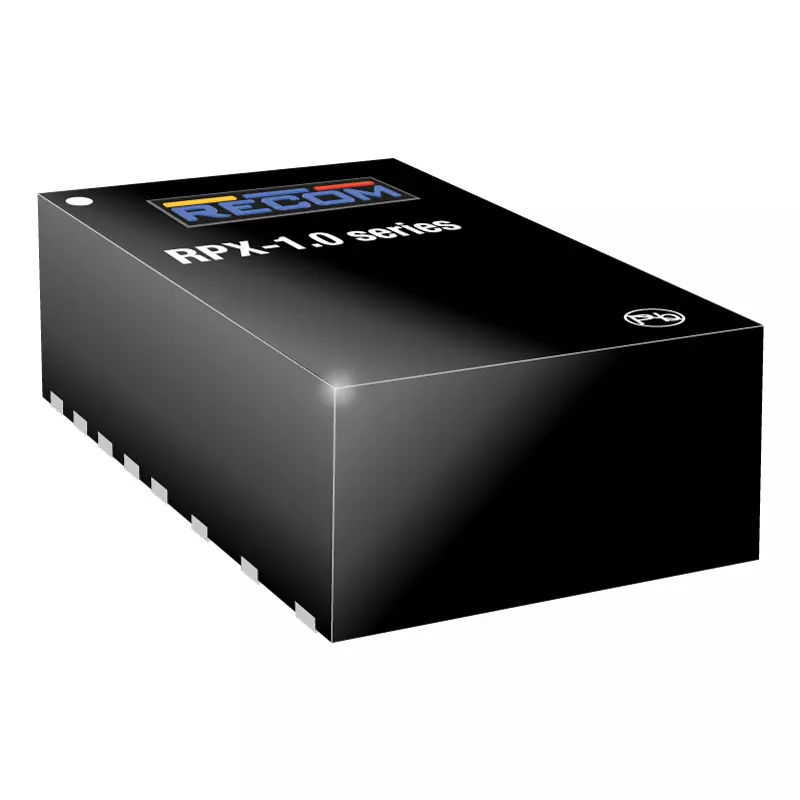
Two RPX-1.0 SMD switching regulator modules generate the adjustable output rails, one in the positive-to-negative configuration. The RPX-1.0 is a complete DC/DC power supply with integrated inductor. Although it can deliver 1A output current, the case measures only 5mm x 3mm with a low profile 1.6mm height. The entire multi-output rail power supply can fit into a 1” x 1” board space by mounting the SMD components under the PCB near the output pins (Figure 5).
An advantage of output-side post-regulators is that the output voltages remain fixed even under highly asymmetric loads. A bipolar output AC/DC has two output voltages, but how do you regulate opposing voltages with one feedback loop? Two options exist: regulate the overall difference between positive and negative outputs and let the common pin (center tap) float (Figure 6), or regulate only the negative output and let the positive float, or vice versa. Under asymmetric loading, e.g., full load on one rail and 10% on the other, the output voltages will also be asymmetric (Table 1).
Fig. 6: Asymmetric outputs with asymmetric loads (regulation across +ve and –ve outputs)
Table 1: Comparison of bipolar regulation methods (typical values for ±12V nominal output). Regulated output shown in blue.
All methods produce the same voltages under balanced loads, but differences emerge with unbalanced loads. Regulating combined voltage keeps the sum of negative and positive rails fixed, while regulating only positive or negative allows variations on that rail. No universal solution exists. Using switching regulators to post-regulate outputs (Figure 4) keeps both output voltages stable across all load combinations, even from no load to full load.
Another benefit of switching regulators: they provide constant power. Lower output voltage allows higher output current. In Figure 4, adjusting outputs to ±3.3V with overall load under 5W allows up to 1.5A per rail, higher than the AC/DC’s nominal 416mA. This accommodates multi-rail applications requiring more power on one rail without affecting others. For example, +12V @ 0.1A, +3.3V @ 1A, and -3.3V @ -0.15A is achievable with tightly regulated outputs. So far, only AC/DC output hacking has been discussed. Hack #3 addresses alternative power sources.
Hack #3: Connect an External DC Supply to AC/DC Outputs
In certain field applications, either AC or DC battery supply may be needed. As shown in Figure 7, connecting an external DC supply to a switched-off AC/DC output causes the output diode, Dout, to prevent current from flowing back through the transformer. However, the shunt regulator, IC1, remains in circuit. If the external voltage exceeds the shunt setpoint, it conducts and feeds current through the optocoupler LED.
With the AC/DC inactive, the optocoupler current is uncontrolled, risking opto-LED burnout. Connecting external voltage directly to AC/DC output is inadvisable. Using two OR-ing diodes can route the higher supply voltage without interaction (Figure 8).
Fig. 7: Typical output stage of an AC/DC converter.
Fig. 8: OR-ing diodes for an AC or an external DC supply.
This hack has two drawbacks: output voltage is one diode drop lower than supply voltage, and power dissipation in diodes is significant at higher currents (3.5W in Figure 8). Large, expensive diodes and heat-sinking may be required, and wasted power can shorten battery life. A better approach is an ideal-diode IC, e.g., Texas Instruments LM71300, with integrated FETs for a compact solution (Figure 9).
This solution protects the battery from deep discharge with under-voltage lockout (UVLO) and protects the application from high surge currents via dVdt control. Load current from both sources can be monitored via Imon outputs.
Fig. 9: Ideal-diode IC controllers for AC or DC battery-supplied equipment.
Hack #4: Implement AC Phase Redundancy
Fig. 10: Phase Redundancy using a half wave three-phase rectifier.
So far, hacks focused on the output side, which is reasonable since AC mains is hazardous. Returning to the EV charger example, it can function with single-phase, multi-phase, or high-voltage DC. This hack addresses the input side.
The half-wave rectified three-phase input (Figure 10) produces approximately 1.17 x Vphase DC, about 270V for nominal 230V single-phase. This exceeds standard 230V±10% AC/DC converter limits but is acceptable for converters rated up to 277VAC.
The circuit uses input fuses to protect each phase if diodes fail, and a metal oxide varistor (MOV) to absorb voltage surges. MOV is optional if the converter has internal fuses but may be required by local wiring codes. Input diodes must have adequate reverse voltage ratings.
If any phase fails, the converter still operates. This is useful for three-phase monitoring applications and alerts for individual phase failures. RECOM /277 series converters support 85-305VAC, allowing use with a neutral connection. Without neutral, phase-to-phase voltage (√3 x Vrms, ~400V) is too high for many AC/DC converters unless designed for such inputs, e.g., /480 series with 85-528VAC or 120-745VDC input.
As mentioned, this hack requires caution due to hazardous voltages. Safety regulations may demand increased creepage/clearance or enhanced insulation, which could make the hack unacceptable. Hard-wired mains circuits must meet over-voltage category III or IV standards.
Hack #5: Output grounding
Fig. 11: Recommended input line filter for grounded output.
AC/DC converters are isolated, with low-voltage DC outputs floating from mains. They can act as positive or negative supplies. For instance, a -48VDC communication bus can use any AC/DC with 48V or ±24V output by tying +Vout to 0V and using –Vout for the supply rail.
In some cases, grounding one output pin is advantageous or necessary. While it may seem simple, regulations for AC/DC converters also include EMC considerations. Circulating or induced currents through insulation capacitance can cause interference, potentially failing EMC testing. Grounding can create unintended current loops; even tens of microamps can affect Class B compliance.
Meeting EMC limits with grounded outputs requires an external line filter with a common-mode choke (CMC) (Figure 11). Two Y-caps create a low-impedance path for interference currents to ground, while the CMC blocks common-mode noise on VAC(L) and VAC(N). The X-cap across the input attenuates differential-mode noise with the CMC’s leakage inductance. A high-ohm resistor across Cx discharges the capacitor when power is off. Pre-built AC line filters are available from suppliers, including RECOM.