24V Battery-Powered Applications in Power Electronics

Person changes a car battery
Battery-powered systems are expanding rapidly, appearing in everything from electric vehicles and motorboats to photovoltaic installations and data centers. A major trend is the increase in system voltages to reduce size and weight and/or increase available power to the load. At the forefront of this trend, enabled by advancements in wide-input power electronics, is the migration from 12V to 24V applications.

What Are Common Applications for 24V Batteries?

All electric vehicles (EVs), including Battery Electric Vehicles (BEVs), contain a conventional 12V lead-acid battery. It serves as an independent power supply for keyless entry and alarm systems, which must function even if the main traction battery is drained, and to supply legacy 12V equipment such as airbags, seat-belt tensioners, and dashboard displays, where recertifying for a different supply voltage would be time-consuming and uneconomical.

In ICE (Internal Combustion Engine) vehicles, the lead-acid battery also acts as a starter battery for the engine. In mopeds and motorcycles, the battery can be 6V; in most cars, it is 12V; and for heavy-duty trucks, it is usually 24V. These multiples of 6V are intentional. In battery-powered applications, across various chemistries (lead-acid, Li-ion, LiFePO4, etc.), the fundamental unit is a battery cell, with a floating open-circuit voltage typically between 1–4V. Higher voltages are achieved by combining cells in series to form a battery pack (often including protection circuitry), though commonly referred to simply as a battery. Cells can also be paralleled to increase output current.

For lead-acid batteries, each cell provides 2V: three cells in series deliver 6V, six cells deliver 12V, and twelve cells deliver 24V. Lead-acid batteries for defense vehicles and aircraft use 14 cells for the standard 28V supply. Lithium-ion cells typically have voltages of 2.4–3V, so a six-pack delivers around 18V, suitable for portable drills and workshop equipment. Lead-acid batteries are generally used in heavy-duty, high-current applications where weight is less critical, while Li-ion batteries are preferred when fast charging and light weight are priorities. Battery chemistry and energy storage, however, are complex, so consulting detailed resources, such as this [1] RECOM blog, is recommended.

While the most common voltages in battery-powered applications are 6, 12, and 18V, there is a growing trend to increase bus voltages to 24V and 48V across various application spaces. The motivations for this trend are outlined in the following section.

Why Move Beyond 12V Batteries Despite Their Widespread Use?

12V lead-acid batteries are more ubiquitous than 24V or 48V solutions and are typically cheaper and more available. For motor starting, a heavy-duty battery can deliver several hundred amps, but the maximum continuous current is limited to around 100A by the wiring loom, limiting available power to roughly 1200W.

Power, Current, and Efficiency Relationships

As shown in the equations below, power is directly proportional to current and voltage, and exponentially affected by current through resistance (e.g., a wire).

Equation: P=I*V

Equation 1: Watt’s Law, where P is power, I is current, V is voltage


Equation: V=I*R

Equation 2: Ohm’s Law, where V is voltage, I is current, R is resistance


Combining Watt’s Law and Ohm’s Law illustrates how current impacts power consumption. Wire resistance results in power dissipation and voltage drop before reaching the end load.

Equation: P=I²*R

Equation 3: Power Loss, where P is power, I is current, R is resistance


Key conclusions:
  • Doubling the voltage to deliver the same power halves the current.
  • Halving the current reduces conductor size requirements to deliver equivalent power.
  • Halving current reduces voltage drop, improving system efficiency.
  • Halving current allows doubling conductor length for the same voltage drop.
  • Halving current reduces power losses in the distribution network to a quarter.

Rising Power Demands and Applications of Higher Voltage Systems

Even as electric vehicles grow, ICE vehicles will continue production for at least the next twenty years, remaining on roads beyond 2050. Innovations such as adaptive suspension, advanced air conditioning control, electrical pumps, turbochargers, and instant engine start-stop systems all demand more power than a 12V battery can supply. A 48V battery system in ICE and hybrid EVs can deliver 5kW while remaining Safe Extra Low Voltage (SELV), allowing conventional wiring insulation and standard safety practices to mitigate electric shock risks. Larger vehicles and battery-powered transportation also have significant wiring weight, sometimes justifying higher-voltage systems to reduce copper usage. Higher-voltage battery packs improve range, whether in fuel or battery life.

These factors translate into real-world advantages: increased power handling, reduced system size, improved energy efficiency, smaller wire sizes, longer wire runs, and enhanced reliability. Higher bus voltages offer substantial benefits. Common opportunities for 24V or 48V batteries include electric motors of all sizes. Small motors in hand tools, boats, golf carts, or wheelchairs benefit from reduced system size and weight, consuming less battery power for supporting wiring and power electronics. Industrial motors and motor-driven systems are the largest energy consumers in many industries [2], highlighting the potential for energy efficiency gains.

Other systems also benefit from higher-voltage batteries. Photovoltaics (PV) illustrate this, as solar arrays are modular and require appropriately sized energy storage. 24V or 48V off-grid solutions can power remote installations like mountain huts, weather stations, or cellular masts, maintaining critical system operation for several cloudy days. The convergence of applications is increasing. Larger boats and RVs benefit from higher battery voltages and integrated PV systems. Defense and high-reliability applications using redundant battery power are also candidates for transitioning from 12V to 24V or 48V systems. RECOM provides a 48V battery-powered AC inverter for marine use, generating 3-phase 115VAC with 1200VA output.

When batteries power sensitive electronics or radio transmitters, stable, regulated supply voltage is critical. Voltage regulators must maximize stored energy usage, support wide input voltage to accommodate fully charged and discharged batteries, and often provide galvanically isolated outputs to prevent ground loops and protect against voltage transients from lightning or electromagnetic interference. Higher isolation is needed in more exposed environments.

Wider Input Voltage Range for Broader Application Coverage

RECOM offers a broad range of cost-effective, sub-miniature, non-isolated voltage regulators for board-level battery-powered equipment, providing wide input voltage, high energy efficiency, and ultra-low standby power, such as the RPM and RPX series. Isolated DC/DC converters with 4:1 input ranges are suitable for 12/24V (9–36V) or 24/48V (18–75V) systems. The RPA150E series delivers 150W of regulated, isolated output over 9–60VDC input, covering 12, 18, 24, and 48V battery voltages in a single eighth-brick package. As an isolated DC/DC converter with an internal planar transformer, it can act as a 24V or 48V bus voltage stabilizer, providing constant, short-circuit-proof output even if the input voltage fluctuates.

Combining higher bus voltages with feature-rich power electronics expands the number and types of applications benefiting from these advancements. Computing applications, both tethered and untethered, such as data centers and laptops, also benefit. Servers running on battery backup gain from placing energy storage close to the load for optimal design and reduced operational energy costs, improving total cost of ownership (TCO). This is achieved using battery backup units (BBU), delivering critical energy storage to the load with zero transition time.

Conclusion

Just as 12V batteries enabled 24V solutions, 24V batteries will enable migration to 48V applications. Consolidating cells into higher-voltage battery packs reduces packaging overhead and increases value. Currently, 24V batteries occupy a sweet spot between 12V and 48V buses, and most large systems can benefit from higher distribution voltages.

References

[1] RECOM, “What is energy storage?” RECOM Blog, Nov 4, 2022, https://recom-power.com/en/rec-n-what-is-energy-storage--233.html
[2] IEA, “Motor-driven system electricity use as a share of electricity use by industry subsector,” IEA, Paris,https://www.iea.org/data-and-statistics/charts/motor-driven-system-electricity-use-as-a-share-of-electricity-use-by-industry-subsector (accessed January 3, 2023).
Applications
  Series
1 RECOM | RPA150E-EW Series | DC/DC, THT, 150W, Single Output
Focus
  • 150W industrial grade isolated DC-DC
  • Compact, industry standard 1/8th brick format
  • 6:1 input voltage range (9-60 VDC)
  • 3kVDC Isolation
2 RECOM | RPM-1.0 Series | DC/DC, SMD (pinless), Single Output
Focus
  • High power density (L*W*H = 12.19*12.19*3.75)
  • Wide operating temperature -40°C to +107°C at full load
  • Efficiency up to 99%, no need for heatsinks
  • 6-sided shielding
3 RECOM | RPM-2.0 Series | DC/DC, SMD (pinless), Single Output
Focus
  • High power density (L*W*H = 12.19*12.19*3.75)
  • Wide operating temperature -40°C to +105°C at full load
  • Efficiency up to 98%, no need for heatsinks
  • 6-sided shielding
4 RECOM | RPM-3.0 Series | DC/DC, SMD (pinless), Single Output
Focus
  • High power density (L*W*H = 12.19*12.19*3.75)
  • Wide operating temperature -40°C to +105°C at full load
  • Efficiency up to 97%, no need for heatsinks
  • 6-sided shielding
5 RECOM | RPM-6.0 Series | DC/DC, SMD (pinless), Single Output
Focus
  • High power density (L*W*H = 12.19*12.19*3.75)
  • Wide operating temperature -40°C to +90°C at full load
  • Efficiency up to 99%, no need for heatsinks
  • 6-sided shielding
6 RECOM | RPX-0.5Q Series | DC/DC, SMD (pinless), 2.5W, Single Output
Focus
  • AEC-Q100 qualified buck regulator power module with integrated shielded inductor
  • 36VDC input voltage, 0.5A output current
  • SCP, OCP, OTP, and UVLO protection
  • 3.0 x 5.0mm low profile QFN package with wettable flanks for optical inspection
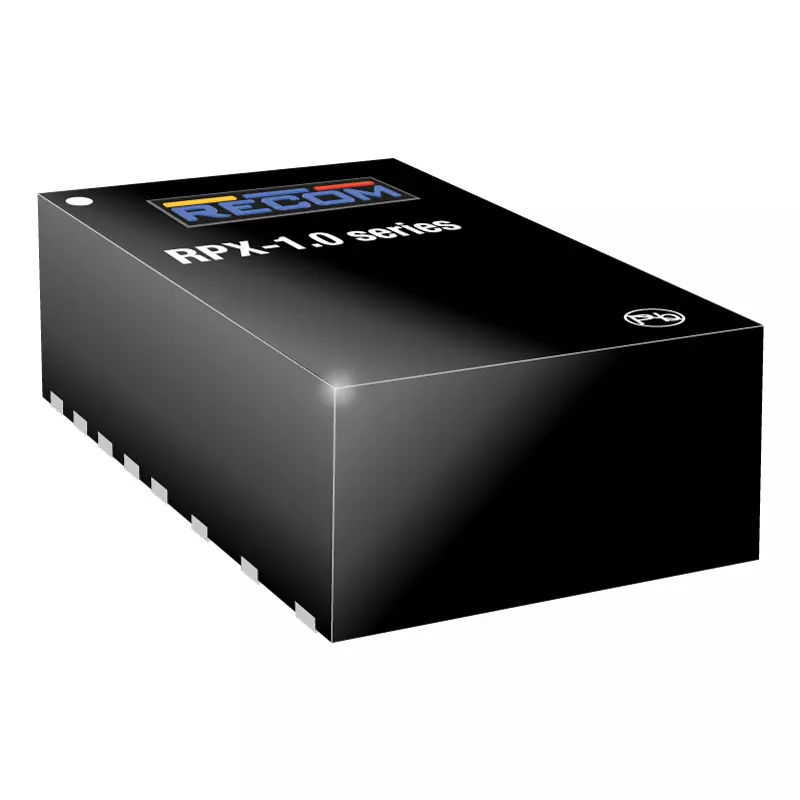
7 RECOM | RPX-1.0 Series | DC/DC, SMD (pinless), 5W, Single Output
Focus
  • Buck regulator power module with integrated shielded inductor
  • 36VDC input voltage, 1A output current
  • SCP, OCP, OTP, and UVLO protection
  • 3.0 x 5.0mm low profile QFN package
8 RECOM | RPX-1.5 Series | DC/DC, SMD (pinless), 7.5W, Single Output
Focus
  • Buck regulator power module with integrated shielded inductor
  • 36VDC input voltage, 1.5A output current
  • SCP, OCP, OTP, and UVLO protection
  • 3.0 x 5.0mm low profile QFN package
9 RECOM | RPX-1.5Q Series | DC/DC, SMD (pinless), 7.5W, Single Output
Focus
  • AEC-Q100 qualified buck regulator power module with integrated shielded inductor
  • 36VDC input voltage, 1.5A output current
  • SCP, OCP, OTP, and UVLO protection
  • 3.0 x 5.0mm low profile QFN package
10 RECOM | RPX-2.5 Series | DC/DC, SMD (pinless), 12.5W, Single Output
Focus
  • Buck regulator power module with integrated shielded inductor
  • 28V maximum input voltage
  • 2.5A maximum output current
  • SCP, OCP, OTP, OVP and UVLO protection
11 RECOM | RPX-4.0 Series | DC/DC, SMD (pinless), 20W, Single Output
Focus
  • Buck regulator power module with integrated shielded inductor
  • 36VDC input voltage, 4A output current
  • Programmable output voltage: 1 to 7V
  • Ultra-high power density: 5.0 x 5.5mm QFN footprint