Down Converter - From the Circuit to the Fully Integrated Power Module

Buck converter circuit diagram
The buck converter has been in use for a century and remains an indispensable element of modern electronic circuits. This article explains how a simple electromechanical component has evolved into a compact assembly capable of handling hundreds of watts of power.

The buck converter transforms an input voltage into a lower output voltage. Its fundamental components are shown in Figure 1. Initially, switch SW1 is closed, allowing current to flow into the coil L1. Since the coil is a differentiating component, the current rises steadily until SW1 opens and SW2 closes, altering the current flow. Capacitor C1 acts as an integrating component, so the resulting output voltage depends on the current and the timing of SW1 and SW2.

Step-down converter circuit diagram
Fig. 1: The basic elements of a step-down converter (Image source: RECOM)

Originally, S1 and S2 were mechanical switches, but these were soon replaced by silicon devices—S1 with a transistor and S2 with a diode.

Circuits Change With Technological Progress

Over time, engineers sought to integrate as many components as possible into the control circuit to reduce cost and size. A major breakthrough was incorporating the main switch, S1, directly into the controller IC, while the coil and diode still required external mounting. Later, to boost efficiency, both switches (SW1 and SW2) were implemented using MOSFETs, enabling switching frequencies up to 2MHz.

Control system diagrams

Fig. 2: The development of down converter integration (Image source: RECOM)

Coil Integration as the Key to Miniaturization

Following the adoption of MOSFETs, the next step was further miniaturization. Higher switching frequencies allowed the coil design to be reduced. Lower current amplitudes decreased the size requirement of the output capacitor, and using higher-quality capacitors with reduced self-heating losses further enhanced efficiency.
Semiconductor assembly cross-section
Fig. 3: Flip chip on leadframe construction
Currently, the focus is on further reducing design size and improving power efficiency. This requires minimizing switched paths and stacking components along the Z-axis.

A prime example is Flip Chip on Leadframe (FCOL) packaging, where the controller IC (with integrated power transistors) is mounted upside down directly onto the leadframe punch grid, adjacent to an SMD choke also attached directly to the leadframe (Fig. 3).
RECOM RPX-2.5 buck converter with dimensions
Fig. 4: The POL module of the RECOM RPX buck converter with integrated chip inductor and flip chip on leadframe design (Image source: RECOM)
This configuration allows fully automated production of highly compact step-down converter modules. Shortened connections of the self-shielding inductor improve EMC performance. Modules produced this way can also be overmolded, resulting in a lead-free QFN (Quad Flat No-lead) package with MSL3 rating and complete environmental protection. An example is the RECOM RPX series (Figure 4), offering a 2.5A output adjustable from 1.2V to 6V in a 4.5 x 4 x 2mm package, requiring only external input and output capacitors.

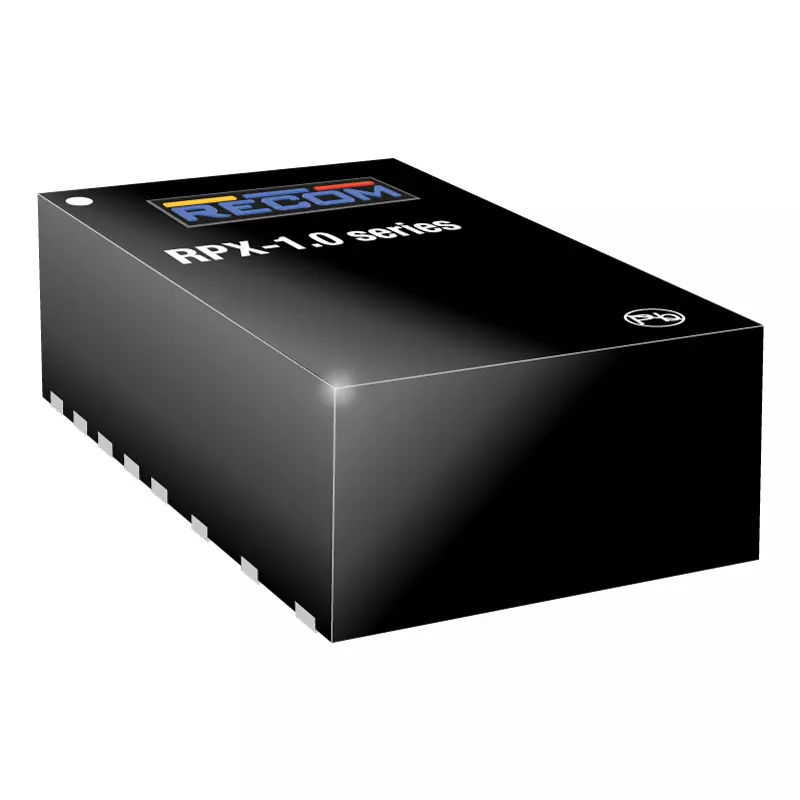
These modules provide a complete solution that can be mounted on the user’s PCB using standard SMD assembly and reflow soldering. RECOM has also introduced two additional RPX series power modules based on FCOL technology: the RPX-1.0 and RPX-1.5 series can deliver up to 1.5A at input voltages up to 36VDC in ultra-compact 3 x 5 x 1.6mm QFN packages.

Conclusion

Buck converters have undergone substantial evolution over many decades. Advances in capacitor, inductor, control IC, and packaging technologies have enabled full integration into increasingly smaller packages with higher power density. Achieving IC-like low-power DC/DC converters is now largely possible through innovative 3D Power Packaging® technologies for both isolated and non-isolated converters, with further gains in performance and power density expected. For general use as modules, fully featured step-down converters maintain comparable size to standard SMT devices and remain suitable for a wide range of end-use applications.
  Series
1 RECOM | RPX-1.0 Series | DC/DC, SMD (pinless), 5 W, Single Output
Focus
  • Buck regulator power module with integrated shielded inductor
  • 36VDC input voltage, 1A output current
  • SCP, OCP, OTP, and UVLO protection
  • 3.0 x 5.0mm low profile QFN package
2 RECOM | RPX-1.5 Series | DC/DC, SMD (pinless), 7.5 W, Single Output
Focus
  • Buck regulator power module with integrated shielded inductor
  • 36VDC input voltage, 1.5A output current
  • SCP, OCP, OTP, and UVLO protection
  • 3.0 x 5.0mm low profile QFN package
3 RECOM | RPX-1.0-EVM-1 Series | DC/DC, 5 W, Single Output
  • Evaluation platform for RPX-1.0 buck regulator module
  • Thermal design considerations included
  • EMI class B filter
  • Easy evaluation of output voltage selection, control, and sensing functions
4 RECOM | RPX-1.5-EVM-1 Series | DC/DC, 7.5 W, Single Output
  • Evaluation platform for RPX-1.5 buck regulator module
  • Thermal design considerations included
  • EMI class B filter
  • Easy evaluation of output voltage selection, control, and sensing functions