In the future of electronics, carbon will play an increasingly important role. This brief blog explores advances in material science where carbon is expected to revolutionize electronics in the coming years.

Carbon Innovations in Power Electronics and Semiconductors
Feb 9, 2024
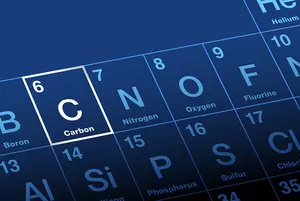
Carbon [C] is an essential element. We are carbon-based lifeforms. In combination with oxygen, gaseous CO2 concentration serves as the barometer for our contribution to global warming. In solid form, pure carbon can be as soft as graphite or as hard as diamond. Carbon fibers reinforce countless products, from airplanes to fishing rods. Radiocarbon 14C dating is an indispensable tool in archaeology. Few elements have a more influential impact.
Table of Contents
Ultra-Wide Bandgap (UWBG) Semiconductors
Wide Bandgap (WBG) transistors based on Silicon Carbide (SiC) and Gallium Nitride (GaN) have already driven rapid improvements in power switching performance. Wider bandgap materials offer significantly higher intrinsic thermal conductivity and greater dielectric breakdown voltage than traditional Silicon (Si)-based MOSFET power transistors, allowing transistor substrates to be made smaller and thinner while maintaining the same performance ratings. The reduced size also lowers gate and terminal capacitances and resistances, resulting in faster, more efficient switching with lower power dissipation.
SiC transistors can handle higher voltages and switch faster and more efficiently than Si-MOSFETs, while High Electron Mobility Transistors (HEMTs) based on GaN substrates can switch even faster than SiC-MOSFETs, making them ideal for high-frequency power electronics. Faster switching reduces the size of supporting inductive and capacitive components, enabling the manufacture of compact, efficient, high power density products.
These WBG advantages make SiC and GaN transistors widely used in green technologies such as electric vehicles, photovoltaic converters, IoT Networks, and eco-design power supplies. Carbon represents the next generation in this evolution – Ultra-Wide Bandgap (UWBG) transistors. Instead of SiC or GaN substrates, pure diamond is used, providing even higher thermal conductivity (4x better than SiC), greater breakdown voltage (6x better than GaN), and a much wider bandgap than both SiC and GaN (Table 1):
Transistor performance can be quantified using the Baliga Figure of Merit (BFOM) – higher BFOM values indicate better performance. The scale is non-linear because critical indicators, such as breakdown voltage and conductivity, depend on the critical electric field, which scales with the sixth power of the semiconductor bandgap electron voltage. Based on BFOM, WBG transistors are approximately 730 times better than Si-MOSFETs, and carbon-based UWBG transistors are about 15,625 times better – a dramatic performance leap essential for transforming global energy consumption from polluting fossil fuels to efficient green electrical energy.
SiC transistors can handle higher voltages and switch faster and more efficiently than Si-MOSFETs, while High Electron Mobility Transistors (HEMTs) based on GaN substrates can switch even faster than SiC-MOSFETs, making them ideal for high-frequency power electronics. Faster switching reduces the size of supporting inductive and capacitive components, enabling the manufacture of compact, efficient, high power density products.
These WBG advantages make SiC and GaN transistors widely used in green technologies such as electric vehicles, photovoltaic converters, IoT Networks, and eco-design power supplies. Carbon represents the next generation in this evolution – Ultra-Wide Bandgap (UWBG) transistors. Instead of SiC or GaN substrates, pure diamond is used, providing even higher thermal conductivity (4x better than SiC), greater breakdown voltage (6x better than GaN), and a much wider bandgap than both SiC and GaN (Table 1):
| Property | Si | SiC | GaN | Diamond |
|---|---|---|---|---|
| Bandgap (eV) | 1.1 | 3.0 | 3.5 | 5.5 |
| Thermal conductivity (W/cm K) | 1.5 | 4.9 | 1.3 | 22 |
| Breakdown voltage (kV/mm) | 0.3 | 2.5 | 3.3 | 20 |
| Electron Mobility (cm2/V s) | 1500 | 400 | 2000 | 1060 |
Table 1: Comparison of basic properties of silicon, WBG, and UWBG transistors
Transistor performance can be quantified using the Baliga Figure of Merit (BFOM) – higher BFOM values indicate better performance. The scale is non-linear because critical indicators, such as breakdown voltage and conductivity, depend on the critical electric field, which scales with the sixth power of the semiconductor bandgap electron voltage. Based on BFOM, WBG transistors are approximately 730 times better than Si-MOSFETs, and carbon-based UWBG transistors are about 15,625 times better – a dramatic performance leap essential for transforming global energy consumption from polluting fossil fuels to efficient green electrical energy.
Graphene-Based Semiconductors

Graphene is a 2-dimensional carbon allotrope formed from nanolayers just one atom thick, arranged in a honeycomb planar lattice. It behaves like a semi-metal, allowing heat and electricity to flow easily along its plane but not transversely. As a bulk material, it strongly absorbs visible light, yet single sheets are nearly transparent. Microscopically, graphene is the strongest known material, with each atom double-bonded to three neighbors. This rigidity creates exceptionally high electron mobility, measured at 15,000cm2/Vs (compare with Table 1), enabling it to conduct electricity better than silver.
Graphene also exhibits unique electrical properties: it is strongly influenced by external magnetic fields, allowing sensitive Hall-effect sensors to operate at room and cryogenic temperatures (down to less than 1K above absolute zero), and it can be used to make graphene-based FETs (gFETs) suitable as biosensors.
A gFET uses a liquid gate, where charged biomolecules affect the channel current, enabling measurements based on ions rather than charge injection. This allows real-time detection of proteins, biomolecules, and nucleic acids, supporting advanced technologies such as CRISPR gene editing, RNA drug research, infectious disease detection in humans, plants, and animals, and cancer research.
Research continues into graphene’s unique electrical properties, which may enable new electronic devices. One promising area is spintronics, where information is stored in electron angular momentum (spin-up or spin-down). Graphene’s regular, rigid structure may serve as an ideal carrier for room-temperature, atomic-level, spintronic non-volatile memory (NVM) that is faster than conventional RAM while retaining all data when powered off.
Graphene also exhibits unique electrical properties: it is strongly influenced by external magnetic fields, allowing sensitive Hall-effect sensors to operate at room and cryogenic temperatures (down to less than 1K above absolute zero), and it can be used to make graphene-based FETs (gFETs) suitable as biosensors.
A gFET uses a liquid gate, where charged biomolecules affect the channel current, enabling measurements based on ions rather than charge injection. This allows real-time detection of proteins, biomolecules, and nucleic acids, supporting advanced technologies such as CRISPR gene editing, RNA drug research, infectious disease detection in humans, plants, and animals, and cancer research.
Research continues into graphene’s unique electrical properties, which may enable new electronic devices. One promising area is spintronics, where information is stored in electron angular momentum (spin-up or spin-down). Graphene’s regular, rigid structure may serve as an ideal carrier for room-temperature, atomic-level, spintronic non-volatile memory (NVM) that is faster than conventional RAM while retaining all data when powered off.
Carbon Nanotubes (CNTs)

If a graphene sheet is rolled into a cylinder, it forms a nanostructure with exceptional tensile strength and thermal conductivity. Thermal interface materials made from vertically aligned carbon nanotubes (CNTs) exhibit highly directional thermal conductivity, efficiently transferring heat from power electronic devices to a heatsink without overheating adjacent components. Thermal conductivities of nearly 15W/K have been achieved – roughly three times higher than thermal grease.
Carbon nanotubes can also behave as semiconductors or semi-metals depending on their physical dimensions or chemical doping. In theory, a carbon nanotube could carry 1000x more current than a similar-sized copper conductor, with current flowing only along the tube axis, enabling new electronic device architectures.
Applications of carbon nanotubes extend to photovoltaics, sensors, displays, smart textiles, and energy harvesters, with the most promising development in Li-Ion batteries using CNT cathodes (Figure 2). Conventional Li-Ion batteries suffer from thermal expansion during fast charging or high discharge rates, damaging the internal structure. The higher mechanical strength of carbon nanotubes withstands these stresses without degradation.
These new CNT cathode batteries can charge from 10% to 90% in 15 minutes, are lightweight, and offer double the WH/kg energy density compared with conventional batteries. They retain 90% of their original capacity after 800 charge/discharge cycles, promising a revolution in electric vehicle performance, where 1000km range could become standard.
Carbon nanotubes can also behave as semiconductors or semi-metals depending on their physical dimensions or chemical doping. In theory, a carbon nanotube could carry 1000x more current than a similar-sized copper conductor, with current flowing only along the tube axis, enabling new electronic device architectures.
Applications of carbon nanotubes extend to photovoltaics, sensors, displays, smart textiles, and energy harvesters, with the most promising development in Li-Ion batteries using CNT cathodes (Figure 2). Conventional Li-Ion batteries suffer from thermal expansion during fast charging or high discharge rates, damaging the internal structure. The higher mechanical strength of carbon nanotubes withstands these stresses without degradation.
These new CNT cathode batteries can charge from 10% to 90% in 15 minutes, are lightweight, and offer double the WH/kg energy density compared with conventional batteries. They retain 90% of their original capacity after 800 charge/discharge cycles, promising a revolution in electric vehicle performance, where 1000km range could become standard.