
UV LEDs for Disinfection and Sterilization
Jul 16, 2021

Ultra-violet (UV) radiation is an effective non-contact disinfection method, killing microbes, bacteria, and viruses, including Covid19, on most surfaces, in water, and in the air. The short-wavelength, high-energy photons disrupt the RNA/DNA in microbial cells and generate free radicals that damage viral genomes, introducing defects that rapidly inactivate pathogens. This disrupting and oxidizing effect makes UV disinfection highly effective and, in many cases, more suitable than chemical or high-temperature methods.
Advantages of UV LEDs Compared to Mercury Lamps
Traditionally, short-wavelength UVA, UVB, and UVC light was generated using mercury vapor lamps. Nowadays, it is more efficient, environmentally friendly, and safer to use LED technology. Mercury discharge lamps convert only about 20% of electrical power into UV radiation, with the remainder lost as IR radiation, making them hot and difficult to use in confined spaces. They operate at very high excitation voltages, posing safety hazards—especially in wet or humid environments—contain toxic mercury vapor complicating recycling, and are fragile and easily broken.
UV LEDs, on the other hand, are more flexible and robust, resistant to moisture, operate at lower voltages, and are more cost-effective than mercury discharge lamps. LEDs are also easily dimmable, allowing precise UV radiation dosages. Another major advantage is tunability: selecting different LED types enables generation of UVA (315-380nm), UVB (280-315nm), UVC (200-280nm), or combinations of these wavelengths. This allows a single PCB layout to serve multiple purposes.
For instance, a combination of blue/white visible and UVA LEDs can treat secondary infections like MRSA or eliminate contaminants in air or water. Visible and UVA radiation, at limited dosage levels, does not harm human skin or eyes. Conversely, populating the design with high-intensity UVC LEDs creates a powerful disinfection lamp, blocking virus or bacteria replication by emitting UV radiation fine-tuned to the 265nm peak absorption wavelength, effectively disrupting RNA/DNA strands.
For instance, a combination of blue/white visible and UVA LEDs can treat secondary infections like MRSA or eliminate contaminants in air or water. Visible and UVA radiation, at limited dosage levels, does not harm human skin or eyes. Conversely, populating the design with high-intensity UVC LEDs creates a powerful disinfection lamp, blocking virus or bacteria replication by emitting UV radiation fine-tuned to the 265nm peak absorption wavelength, effectively disrupting RNA/DNA strands.

Driving and Controlling UV LEDs
Like all high-power visible LEDs, UV LEDs should be driven from a constant current source. Luminance is directly proportional to the current through the LED, not the applied voltage. The current-voltage curve is highly non-linear, so small forward voltage variations significantly affect current if operated from a constant voltage source (Fig. 2). Additionally, forward voltage varies with temperature and between individual LEDs, even from the same manufacturer.When driven by a constant current source, forward voltage variations do not affect the overall current, keeping illumination stable. The LED driver compensates for changes or drifts in LED characteristics, maintaining consistent light output for single LEDs or chains sharing the same current.
The main difference between visible and UV LEDs is operational voltage. 350mA or 700mA visible LEDs typically operate at 3-4VDC, whereas more energetic UV LEDs require 5-6VDC. Therefore, assembling a lamp with five high-power UV LEDs at 350mA requires a higher voltage power supply than the same number of visible LEDs (Fig. 3).

Operating high-brightness LEDs in parallel strings is not recommended, as differences in combined forward voltage create current imbalances. To increase illumination, add more LEDs in series to maintain constant current and brightness. The trade-off is a higher supply voltage for longer strings.
It is permissible to mix UV and visible LEDs in the same string if all share the same current rating, even with differing forward voltages. This can serve as a visible indicator that UV LEDs are active and highlight the beam pattern, making application areas easier to identify.
It is permissible to mix UV and visible LEDs in the same string if all share the same current rating, even with differing forward voltages. This can serve as a visible indicator that UV LEDs are active and highlight the beam pattern, making application areas easier to identify.
What RECOM Solutions Are Available for UV Disinfection?
RECOM offers a range of UV LED driver solutions, including constant-current drivers, dimmable drivers, and compact AC/DC modules designed for UVC disinfection systems.RCDE-48 Series
The RCDE-48 series provides pre-calibrated maximum output currents of 350mA, 700mA, or 1050mA and an input voltage up to 60VDC, sufficient to drive up to 10 UV LEDs. The RCDE-48 series is cost-effective and features a dimming input pin that can also function as enable/disable (pull low to turn off, leave open or pull high to turn on).The output current is linear with the applied voltage, allowing precise dosage control via an external control voltage or manual potentiometer (Fig. 4):


Fig. 4: 15-100% output dimming control using an external voltage


Fig. 4: 15-100% output dimming control using an external voltage
Dimming can also be controlled with a PWM (Pulse Width Modulation) signal for precise 0-100% control using a microcontroller GPIO pin (Fig. 5):


Fig. 5: PWM 0-100% dimming


Fig. 5: PWM 0-100% dimming
The RCDE-48 LED driver is highly efficient (up to 97%), enabling long-lasting portable UV and visible light lamps. A fully-featured mains-powered UV disinfection lamp can be built using just three low-cost RECOM components and a simple IC timer on a PCB <50mm² (Fig. 6), comprising:
The circuit block diagram is shown below:

Fig. 6: UVC lamp circuit diagram with timer and intensity control in <50mm²

Fig. 7: UVC chamber using an AC/DC low-profile power supply. The interlock ensures LEDs switch off when the door opens to prevent human exposure. The red LED visible through the UV-blocking glass indicates that UVC disinfection is active.
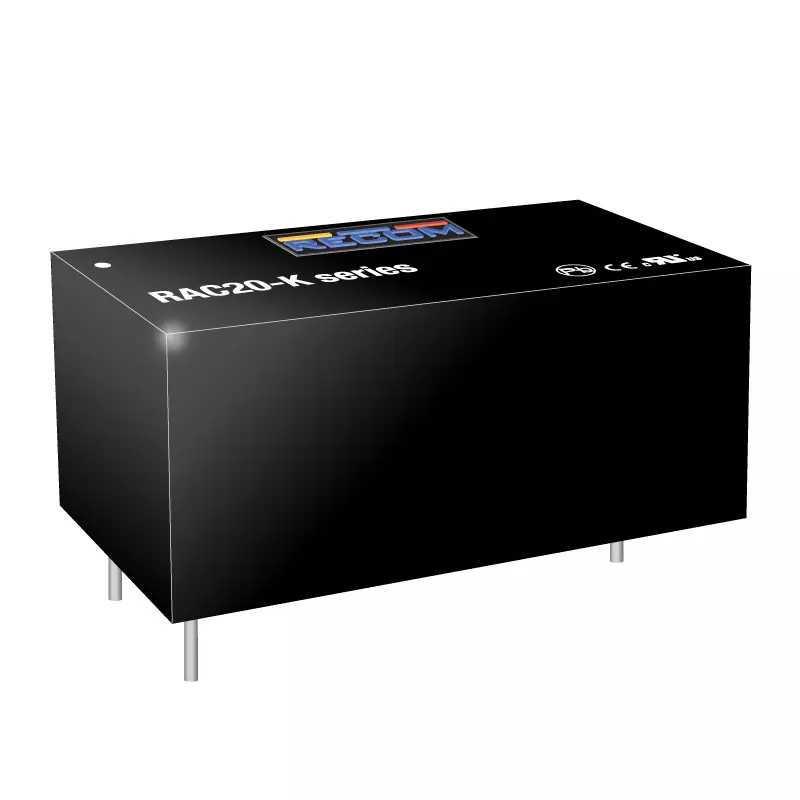
- RAC20-48SK board-mounted AC/DC power supply with universal input (85VAC–264VAC), built-in fuse, EMI filter, and 48VDC regulated, short-circuit-proof output.
- RCDE-48-xxx board-mounted LED driver with constant current output, linear dimming/enable input, and maximum LED drive currents of 350mA, 700mA, or 1050mA.
- R-78HE5.0-0.3 board-mounted switching regulator module to efficiently drop 48VDC to 5VDC @300mA without heatsinking (a linear regulator would run hot with such a voltage drop).
The circuit block diagram is shown below:

Fig. 6: UVC lamp circuit diagram with timer and intensity control in <50mm²
Low-Profile Constant-Current AC/DC Drivers
For UV disinfection applications without dimming, an AC/DC constant current LED driver can be used. RECOM offers a low-cost, safety-certified 20W constant current LED driver in a 13mm low profile, allowing the complete UVC LED PCB and driver to be integrated into the ceiling of a small UVC irradiation chamber:
Fig. 7: UVC chamber using an AC/DC low-profile power supply. The interlock ensures LEDs switch off when the door opens to prevent human exposure. The red LED visible through the UV-blocking glass indicates that UVC disinfection is active.
Applications


| Series | |||||||
|---|---|---|---|---|---|---|---|
| 1 |

|
R-78HE-0.3
Focus
|
|
| |||
| 2 |
|
RAC20-K
Focus
|
|
| |||
| 3 |

|
RCDE-48
Focus
|
|
|