
R-78 Series
RECOM's Field Application Engineer Terry Chang demonstrates the contrast between a linear regulator and the highly efficient RECOM R-78 Series switching regulator.
High Efficient RECOM Switching Regulator
Transcript
Innovation – TechnologyRECOM – WE POWER YOUR PRODUCTS
Hello, I am Terry Chang. I'm a Field Applications Engineer at RECOM Power. Today, I'll show you the difference between a linear regulator and our RECOM switching regulator.
A linear regulator has been used for many years in designs; however, due to the poor efficiency and the heat sink requirements, there have been replacements.
So here we have a linear regulator. The input voltage is 12V. If you increase the voltage, the current will stay the same, so you have increased power coming in but you have the same amount of power going out — meaning efficiency will go down.
Also, it doesn't have short circuit protection, so if you short-circuit it, the input power remains the same, and the short circuit will draw more power. Therefore, the linear regulator is going to burn up, and eventually, it's going to die.
So, here we have our RECOM switching regulator. It is a drop-in replacement for the linear regulator. We have efficiencies up to 97%, so only 3% is lost due to heat —no heat sink is required.
Here, we have the same input power; however, if we increase the voltage, the current will go down. So, we have the same input power, and the converter itself will not use more power as you increase the voltage, because the current will go down.
Additionally, we have short-circuited protection, so if you short-circuit it, the output voltage will go down, the output current will go down. The input power will also go down — so the converter won’t use any power.
| Series | |||||||
|---|---|---|---|---|---|---|---|
| 1 |

|
R-78CK-0.5
Focus
|
|
| |||
| 2 |

|
R-78HE-0.3
Focus
|
|
| |||
| 3 |
|
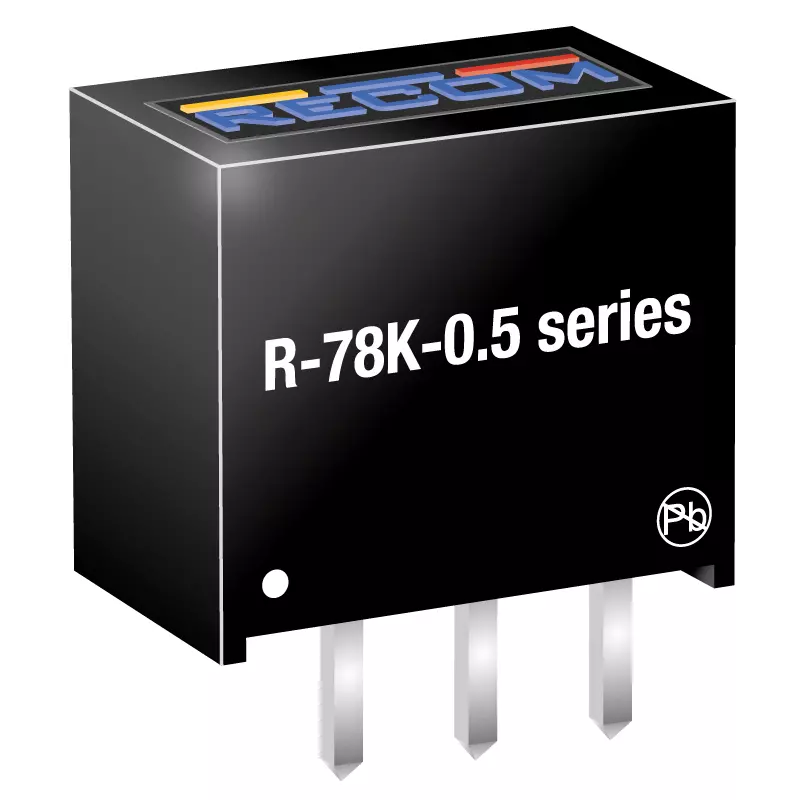
R-78K-0.5
Focus
|
|
| |||
| 4 |

|
R-78K-1.0
Focus
|
|
| |||
| 5 |

|
R-78K-2.0
Focus
|
|
| |||
| 6 |

|
R-78-0.5
|
|
| |||
| 7 |

|
R-78-1.0
|
|
| |||
| 8 |

|
R-78AA-0.5
|
|
| |||
| 9 |

|
R-78AA-1.0
|
|
| |||
| 10 |

|
R-78B-1.0
|
|
| |||
| 11 |

|
R-78B-1.5
|
|
| |||
| 12 |

|
R-78B-2.0
|
|
| |||
| 13 |

|
R-78C-1.0
|
|
| |||
| 14 |

|
R-78E-0.5
|
|
| |||
| 15 |

|
R-78E-1.0
|
|
| |||
| 16 |

|
R-78HB-0.3
|
|
| |||
| 17 |

|
R-78HB-0.5
|
|
| |||
| 18 |

|
R-78HB-0.5/W
|
|
| |||
| 19 |

|
R-78S-0.1
|
|
| |||
| 20 |

|
R-78T-1.0
|
|
| |||
| 21 |

|
R-78W-0.5
|
|
|